
Criminal Cases in the Lee County Courts
Lee County criminal court cases split between two courts at the county courthouse complex in Jonesville. Lee General District Court tries misdemeanors and traffic offenses. It also conducts arraignments, bond hearings, and preliminary hearings in felony matters. A preliminary hearing tests whether there is enough cause to send a felony charge forward. It is not the felony trial. Juvenile and domestic cases fall under Lee Juvenile and Domestic Relations District Court, whose case information is not offered through the public online system.
Lee Circuit Court, part of Virginia's 30th Judicial Circuit, tries felonies, receives grand-jury indictments, and hears appeals from district court. Its clerk holds the case papers and final felony orders. Both court levels may be relevant to one prosecution. A felony can begin in General District Court, gain a new Circuit Court case number, and finish with a plea, trial, dismissal, or sentence in Circuit Court. Search both levels before treating a single result as the whole Lee County court history.
Lee County Criminal Court Counters
The two clerks work at 33640 Main Street, but they keep distinct Lee County criminal case records. The Circuit Court clerk is open from 8:30 a.m. to 4:30 p.m. and can be reached at (276) 346-7763. General District Court is in Suite 209, opens from 8:00 a.m. to 4:00 p.m., and can be reached at (276) 346-7729. Call the court shown on the docket before making a long trip. Ask whether the file is available, what copy choices exist, and what the current fee will be. No official Lee County copy-fee schedule was found in the project research.
The official Circuit Court page shows the local clerk and court details used for felony records.
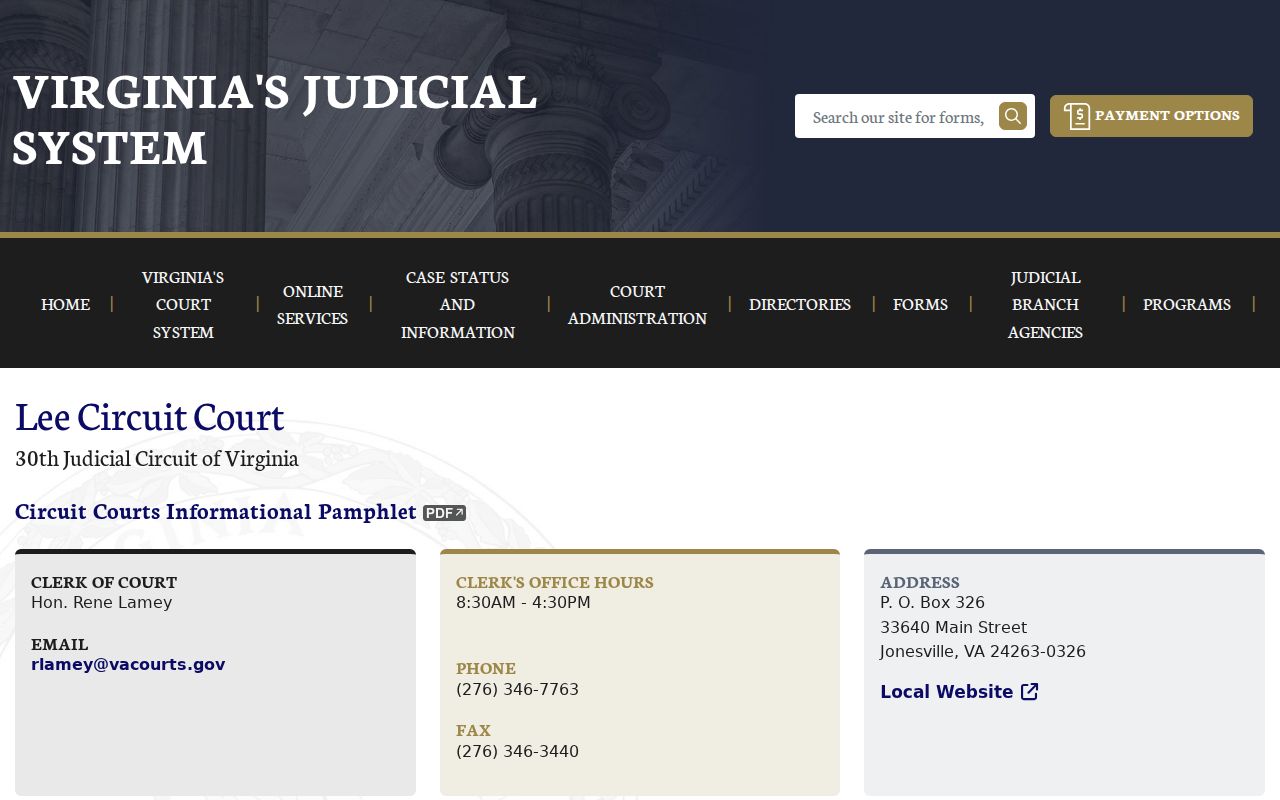
That court page is the best place to confirm current Lee Circuit Court contacts before requesting a felony file or certified order.
Lee Circuit Court Clerk
33640 Main Street
Jonesville, VA 24263
(276) 346-7763
8:30 a.m. to 4:30 p.m.
Lee General District Clerk
33640 Main Street, Suite 209
Jonesville, VA 24263
(276) 346-7729
8:00 a.m. to 4:00 p.m.
How to Search Case Records
Virginia Judiciary Online Case Information System-Statewide Search, or OCIS 2.0, provides the first public check for Lee County criminal court cases. Accept the system terms, select the criminal or traffic case type, choose Lee County, and search by name, case number, or hearing date. A case number is the strongest key. With a name search, compare the court, charge, dates, and case number before deciding that a result belongs to the person sought.
The official OCIS search image below shows the statewide interface assigned to Lee County court research.
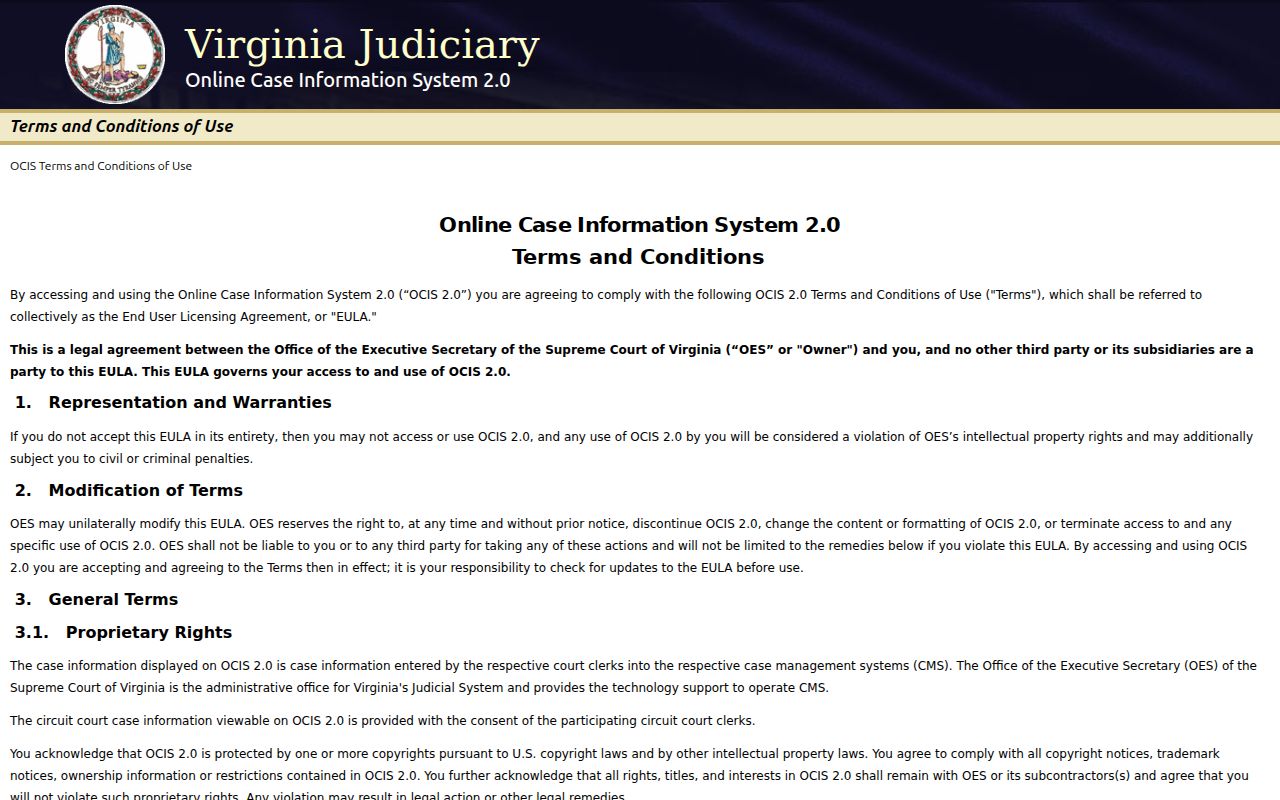
OCIS is a useful index, but the Judiciary's Find a Case guidance explains coverage limits that make the Lee County clerks the final source for missing records and documents.
| OCIS field | How to use it | Limit to remember |
|---|---|---|
| Locality and court level | Select Lee County and the likely court. | A felony may have entries at both levels. |
| Name | Use full last name and first name when known. | Similar names require a date and case check. |
| Case number | Enter the clerk-format number with shown punctuation. | District and Circuit numbers can differ. |
| Hearing date | Search the Lee County docket for a known date. | A reset or continuance can change the schedule. |
| Case type | Choose criminal or traffic as the file requires. | The label does not replace the filed charge. |
Lee County Criminal Docket Days
Lee General District Court publishes a rare agency-specific schedule that can help route a search. In-custody and bonded arraignments are set for 8:30 a.m. on Monday, Wednesday, and Friday. Virginia State Police cases occupy Monday blocks. Sheriff deputy and investigator cases appear in Wednesday blocks. Jonesville police cases are set at 1:00 p.m. on the first Wednesday, while Pennington Gap police cases are set at 1:00 p.m. on the third Wednesday. The schedule helps identify a likely docket, but it does not prove that a named person has a case.
The Lee General District Court source publishes those local docket details.
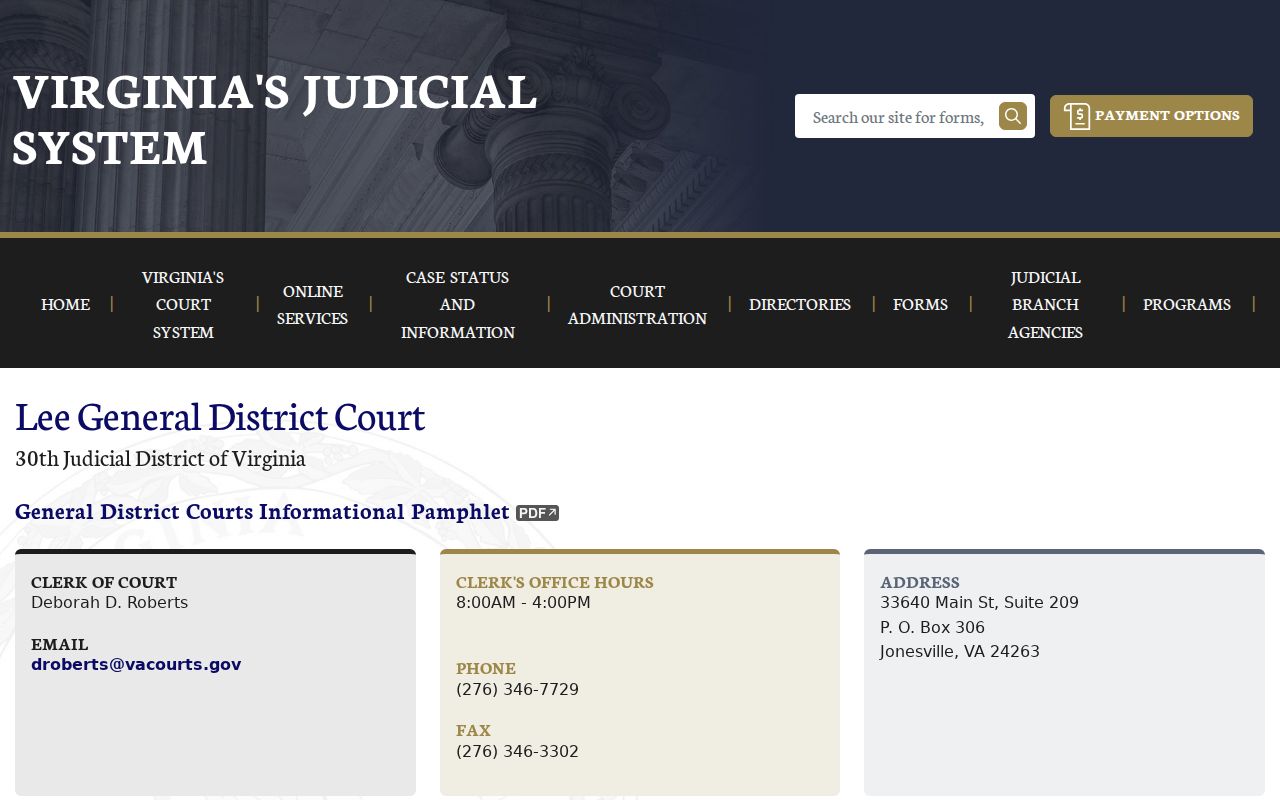
For Lee County criminal cases, the agency blocks can narrow a hearing-date search and point to the clerk most likely to hold the current docket entry.
Note: A published court calendar can change, so confirm the hearing date and time in OCIS or with the Lee County clerk.
What the Case File Shows
A Lee County criminal case file organizes one prosecution around its case number. The online index may show the defendant display, charge, Virginia Code section, offense or arrest date, hearing events, status, disposition, sentence, fine, and costs. The clerk file may also hold process, motions, pleas, orders, and other public papers. Protected data such as full Social Security numbers, certain addresses, victim or minor details, sealed material, and confidential juvenile records does not belong in the public view.
Read the charge, result, and sentence as separate fields. The charge states the allegation filed with the court. The result tells what happened to that charge, such as conviction, dismissal, acquittal, or nolle prosequi. Nolle prosequi means the prosecutor chose not to proceed with that charge at that time. A sentence exists only after a conviction and may include confinement, a suspended term, probation, a fine, or costs.
| Court and case number | Identifies the Lee County court, file, type, and status. |
|---|---|
| Charge | Lists the filed description, Code section, and felony or misdemeanor class. |
| Events | Tracks arraignment, bond, preliminary hearing, continuances, plea, trial, and sentencing. |
| Disposition | Shows the result entered for each charge, not merely the arrest allegation. |
| Sentence | May show jail or prison time, suspended time, probation, fines, and costs. |
| Documents | Usually require a request to the appropriate Lee County clerk. |
Lee County Online Docket Limits
An OCIS screen is not the full Lee County criminal court file. It is an informational case index, not a free image bank for pleadings and orders. Circuit Court participation and older coverage can be incomplete. A case may also be absent because it is juvenile, sealed, expunged, filed under a different spelling, or not yet posted. Online absence does not prove that no criminal case exists. Try a case-number search, check both court levels, and contact the correct clerk when the result stays missing.
The Virginia Judiciary case-information hub explains the available public search choices.
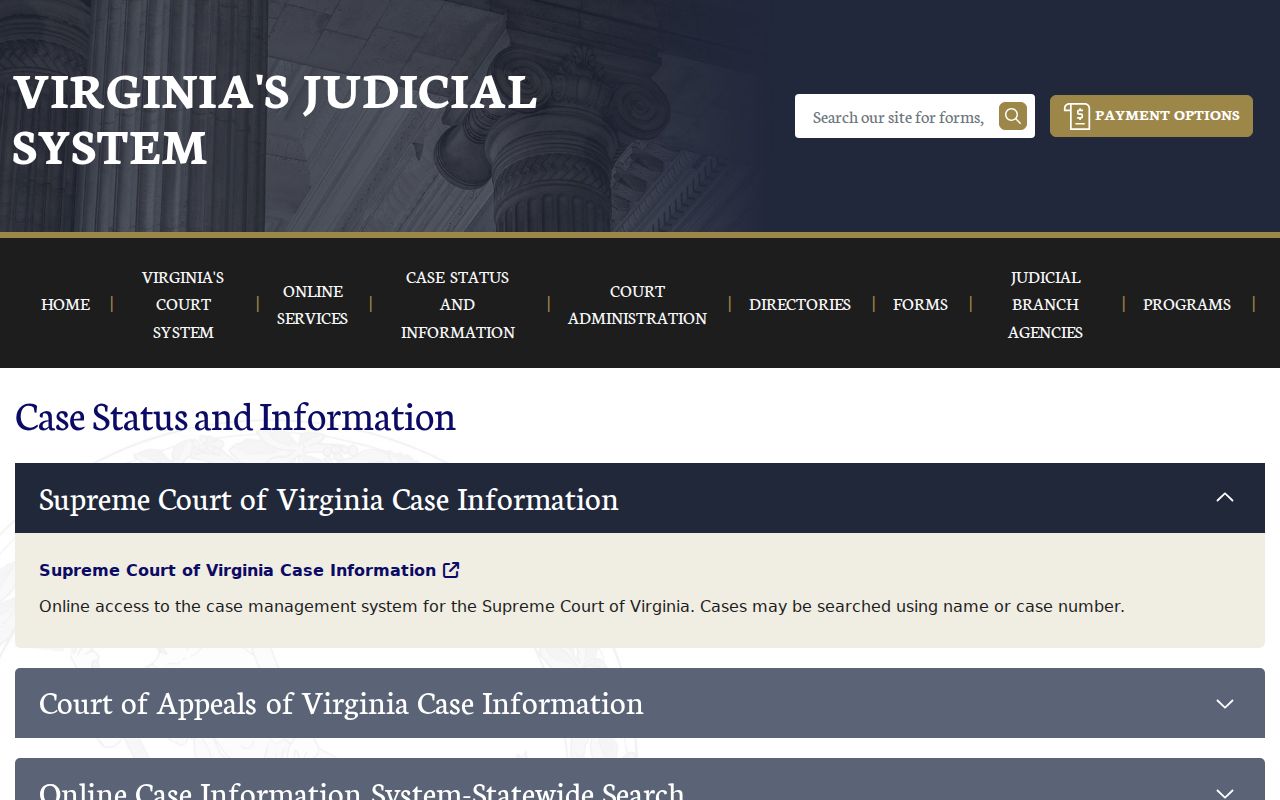
The hub directs readers to public indexes, while document copies and the authoritative Lee County record remain with the clerk.
A screenshot can help note a case number or hearing date. It is not a certified record. Ask the clerk for a plain copy when an informational duplicate is enough, or a certified copy when an official seal and certification are needed. Confirm the fee and delivery method first because the official research did not establish a current Lee County copy price.
Stages of a Criminal Case
A Lee County criminal court case may start with a complaint, arrest, or summons and a magistrate's process. General District Court handles the first stages for misdemeanors and felony complaints. A misdemeanor can go to trial there. A felony can proceed through a preliminary hearing, be certified to Circuit Court, or reach Circuit Court by direct indictment. The grand jury may return a true bill, which means it found probable cause for an indictment. Circuit Court then handles felony arraignment, motions, a plea or trial, disposition, and sentencing.
Case flow: Charges Filed → Arraignment → Pretrial → Plea or Trial → Disposition → Sentencing
A district-court misdemeanor appeal can also move to Circuit Court for a new trial. That path can create related entries at both levels. Use the original court, later Circuit Court number, and each disposition to follow the case. For the arrest event that came before filing, the county's Lee County arrest history resource explains agency and custody records.
Lee County Criminal Case Archives
Older Lee County case research has a local complication. The first courthouse, built in 1794, burned during the Civil War in 1863. Its 1865 replacement burned on February 13, 1933. The current courthouse was built in 1933 and 1934, then expanded on the west side in 1978. These losses and changes help explain why a historical record may require direct clerk or archive work rather than a modern name search.
The Virginia Association of Counties courthouse history documents the building and its past.

The courthouse image connects today's Lee County criminal court counters with a record system that has survived two major fires and several buildings.
For genealogy or old-case research, give the clerk a date range, name variants, court level, charge if known, and any case or order number. Be ready for a manual search. Do not assume that an older file was digitized or that missing online data means the paper record was destroyed.
Access & Restrictions
Virginia Code § 17.1-208 governs inspection and copying of records in clerks' offices, subject to other law and clerk control. The Virginia Freedom of Information Act applies to many government records, but a court document request should go to the court clerk instead of being framed as a sheriff records request. Repository criminal-history data follows the narrower rules in Virginia Code § 19.2-389.
Juvenile court data is not available through the public online judiciary system. Sealed and expunged matters, protected victim and minor information, full financial identifiers, and some active investigative facts can also be withheld from public access. A public docket does not include every paper in the clerk's file. Ask for a specific order, docket sheet, indictment, or disposition rather than requesting a vague background file. Federal cases belong to the U.S. District Court for the Western District of Virginia, not a Lee County clerk.
Virginia access law preserves public court inspection while protecting sealed cases and sensitive data. The Lee County clerk controls copies from the file it maintains.
Correct a Lee County Case Result
If a Lee County criminal court result looks wrong, first compare the OCIS entry with the signed order or certified disposition from the clerk. A charge can change between arrest, preliminary hearing, indictment, and final judgment. Send the correction request to the source that created the error. The clerk addresses a court entry. The arresting agency addresses its report. Virginia State Police CARE addresses a repository-history mismatch after the source disposition is obtained.
A dismissal does not by itself promise that every public trace has vanished. Virginia expungement under § 19.2-392.2 and the separate Chapter 23.2 sealing system have eligibility rules and changing effective dates in 2026. Review the operative law and current Judiciary forms before filing in Lee Circuit Court. Keep the signed relief order, then check the public court view and one's own VSP record. If an eligible record remains visible at its source, provide that source with the order and dispute the mismatch.